Showing posts with label Jazz. Show all posts

Saturday, April 19, 2014

The Rascals "Once Upon A Dream" 1968

If you bring up the Rascals in conversation with me, you are pretty darn cool.  However, very few people do.  I still remember the first time I heard this album.  My old buddy PJ let me borrow this on vinyl back in 2004 or 2005.  I think he said his dad gave it to him.  Albums by bands that had really big hits in the mid 60’s and then progressed have always fascinated me.  I guess you could say that about a million bands but it’s the albums like this that are really neat.  What I like about it is that it keeps that classic “Rascals” sound but expands on it in not only a profound way, but a cool way.  It’s not like they just put a bunch of stings and horns and harps on their existing sound and then called it “forward thinking” music.  This is heartfelt and rockin', dark and reassuring. 
                The first thing that hit me about this record was how murky it sounded.  Where did they record this, under somebody’s house?  It’s like a cloud garden and each song is like a puff of smoke rising out of a long forgotten fire.    
There is also an easy going quality to this album.  Sometimes it reminds me of a relaxing day.  Of course there are two kinds of relaxing days: the ones you have to try to make relaxing, and the ones that are relaxing all by themselves.  This album is the latter.  “Easy Rollin” feels like you are driving 50 mph on a smooth highway. That classic “Rascals’ organ” smooths everything out nicely and makes it feel like the wind is gently blowing your hair.  Nothing feels forced on this record; everything is a logical progression from their earlier sound.  I also love the ending of this song where the tape slows down and the organ falls. 
“Rainy Day” is a gorgeous slice of orchestral grandiosity mixed with unpolished vocals, and…wait for it…syrup.  It’s just enough though.  “Syrup” or “Syrupy” usually has a connotation of something overly sweet on an album.  Not here.  If you were eating pancakes, you could compare the syrup factor to about ¼ of the way into your meal.  That is the point where you are still really digging the sweetness, but aren’t sick of it yet.  I also really dig the bridge where everything speeds up for a few bars.  It feels like some 50’s action adventure safari soundtrack.  Just lovely. 
What strike me about “Please Love Me” (my wife’s favorite) and “It’s Wonderful” are the background vocals.  They are wonderfully high and piercing.  I think what I like about them is that they feel like regular guys singing with their regular voices.  These aren't the angelic tones of the Beach Boys or the silky smoothness of The Association that I usually get caught up in.  These are very functional background vocals.  It’s like they were in the studio and said, “Can you sing the lyric ‘please’ really high and shrilly? You can? Great!  Go do it, and then do the same thing on “It’s Wonderful.”  And just like that, the background vocals were done.  As I have stated in other reviews, it is that lack of pretension that makes it feel so raw and compelling. 
                When I think of this album, I find that songs from the first side tend to pop into my head first.  The songs are a little punchier and to the point.  However, the second side has some very pretty songs that are very much of their time.  “Sattva” with its sitar and chants of “this is love” is pure 1968.  But it’s the second part of the song that blends the more straight forward Rascals’ sound with the hook.  I think the real accomplishment here is that they didn’t just try to just do an “Indian” song.  They blended it successfully with their own sound, making it something much more special. 

Tones:  There are several songs that feature some very jazzy saxophone playing by King Curtis.  Most bands that incorporated sax into their sound did so in more of a honking R&B way.  The Rascals were able to explore jazz elements, which was rare in the late 60’s.  The jazz accents are one reason I find this record so compelling and original.  When you listen to bands like The Beatles and the Beach Boys, you hear them pushing boundaries, but not in the way the Rascals do.  The Rascals would move in this direction even more as they moved into the 70’s.

Cover Note:  The inside says that the drummer, Dino Danelli, was responsible for the cover.  I feel like this is an interesting cover, but I wouldn’t want to see these artifacts in person.  It’s very grey/blue, and if my mind did not attach the artifacts to the music, I would be uncomfortable.  I also have to say that the gatefold on this record (and all my late period Rascals’ records) is extremely high quality, and has/have held up nicely. 

Price Paid:  $3.00 and I have gotten so much joy out of this one.  It isn’t a terribly hard one to find either. 

Bottom Line:  This was one of the first records I found that was not an obvious classic.  It took me a few listens before I really fell in love with it and I think the same was true for my wife.  She never made any comments about the record until I had been playing it for a few days.  After that, she had all kinds of things to say.  For example, she can’t decide if she likes or dislikes the sped up vocals at the end of “It’s Wonderful.”  I find that fascinating and it gives us something to talk about each time we listen together with our son.  My wife and I have also had a great time singing, “I’m Gonna Love You Any Way I Can” to our boy.  You can totally get away with playing this one around your family.  They’ll love it.  It’s wonderful.   


Saturday, March 22, 2014

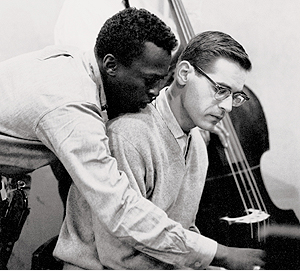
Bill Evans Trio "Everybody Digs Bill Evans" 1958

It took me some time to realize how amazing Bill Evans was.  Sometimes music hits you over the head, but sometimes it just gets slipped under your pillow.  Bill Evans always seemed like a fragile character to me and I pick up a lot of that from the music.  He can also really swing though.
 Bill was the king of impressionist harmony, which will only mean something to you if you are a musician.  You may have heard of impressionist painters. Well, whenever I look at their paintings, I always enjoy their hazy quality.  The clarity is gone therefore I am forced to focus on other aspects.  Well, what they do with painting, Bill does with harmony.  To do this, he stays away from the obviously pleasant (and familiar) sounding notes in a chord.  These would be the ones that make up about 98% of all written music.  Instead he plays notes that are close to the “good” notes, creating an impression of the chord.
 Think about it like this.  If you go outside on a sunny day and look up in the sky, the sun can hurt your eyes.  So what do you do?  You put you hand up to cover the sun, and try to decipher what you can.   You aren’t seeing an accurate representation of what the sky really looks like; you just get an impression.  You have lost the key element, so now you are forced to focus on the rest.  This is why Bill Evans’ music sounds the way it does.  I hope that makes sense.  Please do not translate that into, “Bill Evans was an impressionist painter who couldn’t see the sun, so he played wrong notes on the piano.”    
“Minority” starts off sounding pretty menacing for a jazz record.  They make me think of someone slipping through prison bars.  These jagged sounds are coming from the same guy who played the beautiful opening chords on Miles Davis’ “Kind of Blue” album.  The main melody is quite memorable and swings elegantly.  I really dig how Bill’s solo builds momentum.  It starts off slow and gets fancier as it progresses.  The more I listen to this, the more impressed I am by how planned out it seems.  Bill starts to trade solo breaks with drummer Philly Joe Jones and they taunt each other back and forth.  Some of Bill’s runs sound like mice running across the floor.  Very hip jazz mice. 
On the emotional flip side, you get “Young and Foolish” which is melancholy at its best.  If I had to be sad, this is the kind of sad I would want to be.  Not the real thing, but an oozing, gray version of it.  Bill’s piano rolls like constant thunder clouds dimly pushing their way out of an old movie projector.  Just when I think that being gloomy is great, Bill hits some harsh dissonant notes that feel like pangs of guilt or loneliness.  It’s really quite emotional. 
          One thing I like about this record is the interesting sequencing of its songs.  The slightly eastern sounding “Epilogue” after “Night and Day” closes side one beautifully.  Bill has a way of letting strange chords ring out with an uncomfortable beauty.  They are like looking at a beautiful woman who scares the hell out of you.  The same little “Epilogue” pops up again at the end of the record. 
                Side two also contains what I consider to be the centerpiece of the record: “Peace Piece”.  Bill’s left hand plays a creamy repeated figure, and his right hand improvises.  The first half of the song is wonderfully calm and relaxing, like warm sheets on a cold day.  Conversely, the second half is much more challenging to relax to.  The notes feel like sharp little pebbles or drops of black ink on canvas.  The left hand keeps going though.  You may still be lying in those warm sheets, but you just got your heart handed to you by your lover.  My wife loves the first half of this song, but gets frustrated by the second half.  I think most people who are not into modern jazz would be too. 
               
Tones:  This is a three piece jazz combo, so there is not a lot of tone variety.  You do, however, get some changes in texture that are quite charming.  “Oleo” starts with mostly bass and piano.  Halfway through, the drums crash in as Bill pays some chromatic bumblebee runs.  These guys must have been aware that three instruments can only create so much variety.  As a result, you get some fascinating interplay that generates patches of sound that very much hold my interest.

Cover Note:  This was an innovative cover back in the day.  Miles Davis, George Shearing, Ahmad Jamal, and Cannonball Adderley all sing Bill’s praises.  In 2014, it’s hard to be shocked by a cover like this, but I am sure it stood out back in 1958.  Seriously, if Miles Davis thinks you’re cool, there’s a pretty good chance you are.  I’d probably buy a sandwich if I thought Miles dug it. 

Price paid:  I have a vinyl reprint that I bought online for about $16.00.  I feel like finding old jazz is pretty hard to do.  Every time I look for old jazz stuff, it’s either scratched, or way out of my price range.  I don’t think this stuff was ever majorly popular to begin with, so copies are rare.  I have no problem buying a new reprint of an old album.  Besides, jazz on vinyl is a special thing. 

Bottom line:  You have to be sensitive to appreciate an album like this.  Sure, if you are a musician, you can dissect the complex harmonies and technical intricacies, but where does that leave you?  Musicians don’t push the boundaries of harmony just to push them.  They do it so they can convey new, deep, and hopefully insightful emotions.  The greatest part about this album is its ephemeral nature.  The Bill Evans Trio was certainly in the moment when they created this record, and what a great moment it must have been to be in.    

Thursday, March 6, 2014

Speedy West "Steel Guitar" 1960


                In both its pedal and non-pedal forms, steel guitar is one of my favorite instruments.  It’s a highly emotional instrument with very few limits.  While many instruments (such as horns) are limited to single notes, steel guitars can play single note melodies, double note harmonies, and full complex chords.  Notes can also be slid into, and volume and tone (thanks to electricity) can be altered to great effect.  Speedy West makes use of every sound imaginable from this amazing instrument.  He also creates sounds that are other worldly and downright weird.  If you are looking for a record that contains only pleasant background steel guitar playing, then “Steel Guitar” is not your record.  If you are looking for a record with playing that is fun, playful, strange, bombastic, innovative, and smile inducing, then “Steel Guitar” is your record. 
                “Speedin’ West” starts things off with a vivacious beat and some fancy twin lead playing.  I would be interested in talking to Speedy to see what kind of emotion he was trying to express in this song.  There is a playful, cartoon jubilance that bounces straight off this song into your ears.  The solos are about as zany as you can get.  You might be fooled into thinking Speedy was just messing around if the things he came up with weren’t so difficult to play and express.  If you tried to convey what Speedy plays with only words and facial expressions, it would be extremely difficult.  Either that or people would think you are a delightful maniac. 
                There is a lumbering exotic vibe to “West of Samoa.”  A slippery low guitar, which descends like a boa constrictor down a tree, sets the tone.  In the background, birdcalls (an Exotica staple) are created by an electric guitar.  It’s only an approximation of a birdcall, which makes it sound that much stranger.  The main melody is a wonderful Hawaiian tune that drips with humidity.  It’s lazy, breezy, and calm.  Back and forth, the two parts of the song alternate between the dark and the daylight.  It’s the perfect mix of eeriness and beauty. 

                It is important to recognize the work of Jimmy Bryant, who plays guitar on this album as well.  Not doing so would be like not mentioning Art Garfunkel when you talk about Paul Simon, or Billy Strayhorn when you talk about Duke Ellington.  Speedy and Jimmy were musical partners and pushed each other on their respective instruments.  Jimmy incorporated a lot of Be-Bop into his country licks.  He was also the first guitarist to kill it on the Telecaster.  This guy absolutely rips, and his Telecaster really gave him as distinctive tone compared to other jazz and country players of the day.  Take a song like “Caffeine Patrol.”  Jimmy trades solos with Speedy, and starts with some lyrical and catchy playing that experiments with wide intervals between notes.  In his second break, he pulls out some straight up Charlie Parker Bop, that sounds like a line of freshly blown bubbles popping in succession.   
                Other highlights on this album include “This Ain’t the Blues,” which has Speedy creating some vocal like effects on the steel.  As I listen to this song, the sounds (which I love) remind me of my high school Spanish class (which I loathed.)  I remember my teacher showing us how to “roll our R’s” with our tongues.  Speedy actually creates a similar sound as he plays the melody.  “Stealin’ the Moonlight” is a slow moving beauty with some juicy triplets that keeps things interesting.  This is exactly the song you (as in me) would want to hear at 1:30 in the morning at a smoky bar.  Also, pay attention to Jimmy Bryant’s dazzling guitar lick at the very end of the song.
Tones:  Picture the craziest Psychedelic 60’s album cover you can imagine.  That is what Speedy’s playing sounds like to me.  He is able to create some of the most out there tones on the steel guitar that I have ever encountered.  Sometimes it sounds like a synthesizer, and sometimes it sounds like a squirt of water in the face. He also gets some great wah wah sounds by playing with his tone control.  It’s not all weird though; he can also rein it in and play sweetly and elegantly. 

Cover note:  Lots of steel guitars!  Did I mention I like the look of steel guitars as well?  They are so simple, sleek and clean.  I count at least 18 (some are just pieces though) on the cover.  I like the purple one to the left of Speedy’s head best. 

Price Paid:  $1 or $2 at a record show at the fairgrounds.  It did not have an inner sleeve, but it looked like it was in good condition (which it was.)  I had never heard of Speedy, I just knew I liked steel guitars, and his name sounded awesome (which it is.)  It is one of my great pleasures in life to be able to try new music on vinyl for small amounts of money.  Some are duds, but then you find fun stuff like this.  What a joy!
Bottom line.  Good for people who like Country, Jazz, Texas Swing, Hawaiian, Exotica, and novelty music.  It’s the kind of record that you can play for your family because it’s fun on a superficial level.  They can be diggin’ how fun it sounds, but you can be grooving on all the cool technical stuff Speedy and Jimmy play.  Not only that, you can point out all of the amazing musicianship to your buddies who are music lovers like you.  $3, $4, or $5 would be a nice asking price. One more thing, this is not a stereo recording.  It plays in glorious mono!

Wednesday, February 12, 2014

Duke Ellington "Far East Suit" 1967

                The title sounds exotic, right?  And it is, just in a heavily jazzy way.  I bought this with no prior knowledge other than the fact that Duke is the king, and the cover and title were appealing.  The funny thing is that even though it is supposed to be inspired by the Far East, it actually has more of a jungle vibe than many other records with “jungle” in the title do.  This is dark and pulsating, thick and hot, complex and woody.  It’s very much a “Far East” record, but it has that low rumble of a jungle LP. 
                The opening chord played by the horns in “Tourist Point of View” is so dense, the notes so close together, that it feels like someone’s put a mosquito net on your face.  The ride cymbal in the background clanks away and the sax moans and moans then screams like a flaming teapot.  This reminds me of some heavy Mingus stuff.  I know Mingus was inspired by Duke, but I’m more familiar with Mingus’ music.  As I’m listening to this, my pulse is a bit elevated, and my breaths are shorter than usual.  Its burning intensity affects you physically.  It’s like the coals at the bottom of the fire. 
                “Bluebird of Delhi (Mynah)” is brilliant.  Birdcalls are some of the bread and butter in Exotica, but rarely are they actually played by instruments.  In this case, a clarinet plays a repeating figure before launching into an almost cartoonesque (as in animated, fun, and energetic) solo.  Have you ever walked into a room and suddenly been confronted by an animal staring at you.  It’s a weird feeling.  If I had to write a story to this song, I would say this: A man walks into a room and sees a bird staring at him.  The bird makes some strange noise at him, and then suddenly flies around the room knocking every piece of glass off the shelves it can find.  It then settles, stares deeply into the man’s eyes, and gives the same call as before, just as the man’s friends walk into the room. 

                “Blue Pepper” is my favorite on the record, and is typically the one I have to listen to more than once.  This one has some serious swankiness to it and really grooves to that “Now Sound” beat.  There are massive amounts of space in the solos, which really lets you concentrate on how fat that groove is.  This is part spy movie, and part old-school strip tease.  The melody is slippery as an eel, but still easy to hold onto.  I am not sure I would want this to be my theme song, but if people happened to think of this song as I walked into a room, then I think we would all be better off.  Also, is it just me or does the trumpet seem impossibly high?
                “Amad” sounds the most Middle Eastern out of the lot.  I love jazz with lots of chord changes, but a song like this (with none) really hits the spot for me.  Duke’s melody ideas over the single chord really show you why he is so impressive.  The harmonies scratch at you like a tiger and the metallic piano bubbles in the background.

Tones:  The doubled saxophone on many of these numbers is very appealing.  It’s a very jazzy sound in general, and it sits in my gut well.  There is also some very good use of stereo panning.  Nothing really ping-pongs per se.  It’s more of a call and response between two sets of horns.  You get mid range horns on the left, baritone horns on the right, and solos in the middle.  The drums get a lot of my attention as the songs goes by too. 
Cover Note:  This cover is a cornucopia of Far East imagery.  I feel like the orange background color (lovely by the way) feels a bit like a desert.  Instead of the usually lush and wet Exotica covers, you get one more sandy and arid. 

Price paid:  $5.00 at Gary’s backyard record sale. 

Bottom line:  If you are someone who does not really like jazz a lot, but are into exotic type sounds, this may be good for you.  It’s important to remember that Duke was a composer, so there is a lot more going on here texture wise other than just solos and rhythm.  It’s also nice to have the focus on Middle Eastern sounds in addition to the jungle stuff.  Most of my exotic albums are of the Hawaiian, African, or Latin variety.  This is a wonderful change up.  I think this could easily go in the $10.00 range.