Showing posts with label Very Technically Gifted. Show all posts

Saturday, March 22, 2014

Bill Evans Trio "Everybody Digs Bill Evans" 1958

It took me some time to realize how amazing Bill Evans was.  Sometimes music hits you over the head, but sometimes it just gets slipped under your pillow.  Bill Evans always seemed like a fragile character to me and I pick up a lot of that from the music.  He can also really swing though.
 Bill was the king of impressionist harmony, which will only mean something to you if you are a musician.  You may have heard of impressionist painters. Well, whenever I look at their paintings, I always enjoy their hazy quality.  The clarity is gone therefore I am forced to focus on other aspects.  Well, what they do with painting, Bill does with harmony.  To do this, he stays away from the obviously pleasant (and familiar) sounding notes in a chord.  These would be the ones that make up about 98% of all written music.  Instead he plays notes that are close to the “good” notes, creating an impression of the chord.
 Think about it like this.  If you go outside on a sunny day and look up in the sky, the sun can hurt your eyes.  So what do you do?  You put you hand up to cover the sun, and try to decipher what you can.   You aren’t seeing an accurate representation of what the sky really looks like; you just get an impression.  You have lost the key element, so now you are forced to focus on the rest.  This is why Bill Evans’ music sounds the way it does.  I hope that makes sense.  Please do not translate that into, “Bill Evans was an impressionist painter who couldn’t see the sun, so he played wrong notes on the piano.”    
“Minority” starts off sounding pretty menacing for a jazz record.  They make me think of someone slipping through prison bars.  These jagged sounds are coming from the same guy who played the beautiful opening chords on Miles Davis’ “Kind of Blue” album.  The main melody is quite memorable and swings elegantly.  I really dig how Bill’s solo builds momentum.  It starts off slow and gets fancier as it progresses.  The more I listen to this, the more impressed I am by how planned out it seems.  Bill starts to trade solo breaks with drummer Philly Joe Jones and they taunt each other back and forth.  Some of Bill’s runs sound like mice running across the floor.  Very hip jazz mice. 
On the emotional flip side, you get “Young and Foolish” which is melancholy at its best.  If I had to be sad, this is the kind of sad I would want to be.  Not the real thing, but an oozing, gray version of it.  Bill’s piano rolls like constant thunder clouds dimly pushing their way out of an old movie projector.  Just when I think that being gloomy is great, Bill hits some harsh dissonant notes that feel like pangs of guilt or loneliness.  It’s really quite emotional. 
          One thing I like about this record is the interesting sequencing of its songs.  The slightly eastern sounding “Epilogue” after “Night and Day” closes side one beautifully.  Bill has a way of letting strange chords ring out with an uncomfortable beauty.  They are like looking at a beautiful woman who scares the hell out of you.  The same little “Epilogue” pops up again at the end of the record. 
                Side two also contains what I consider to be the centerpiece of the record: “Peace Piece”.  Bill’s left hand plays a creamy repeated figure, and his right hand improvises.  The first half of the song is wonderfully calm and relaxing, like warm sheets on a cold day.  Conversely, the second half is much more challenging to relax to.  The notes feel like sharp little pebbles or drops of black ink on canvas.  The left hand keeps going though.  You may still be lying in those warm sheets, but you just got your heart handed to you by your lover.  My wife loves the first half of this song, but gets frustrated by the second half.  I think most people who are not into modern jazz would be too. 
               
Tones:  This is a three piece jazz combo, so there is not a lot of tone variety.  You do, however, get some changes in texture that are quite charming.  “Oleo” starts with mostly bass and piano.  Halfway through, the drums crash in as Bill pays some chromatic bumblebee runs.  These guys must have been aware that three instruments can only create so much variety.  As a result, you get some fascinating interplay that generates patches of sound that very much hold my interest.

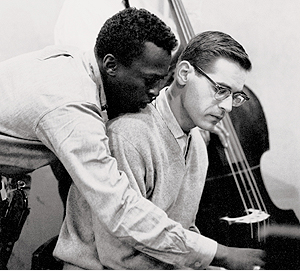
Cover Note:  This was an innovative cover back in the day.  Miles Davis, George Shearing, Ahmad Jamal, and Cannonball Adderley all sing Bill’s praises.  In 2014, it’s hard to be shocked by a cover like this, but I am sure it stood out back in 1958.  Seriously, if Miles Davis thinks you’re cool, there’s a pretty good chance you are.  I’d probably buy a sandwich if I thought Miles dug it. 
Price paid:  I have a vinyl reprint that I bought online for about $16.00.  I feel like finding old jazz is pretty hard to do.  Every time I look for old jazz stuff, it’s either scratched, or way out of my price range.  I don’t think this stuff was ever majorly popular to begin with, so copies are rare.  I have no problem buying a new reprint of an old album.  Besides, jazz on vinyl is a special thing. 

Bottom line:  You have to be sensitive to appreciate an album like this.  Sure, if you are a musician, you can dissect the complex harmonies and technical intricacies, but where does that leave you?  Musicians don’t push the boundaries of harmony just to push them.  They do it so they can convey new, deep, and hopefully insightful emotions.  The greatest part about this album is its ephemeral nature.  The Bill Evans Trio was certainly in the moment when they created this record, and what a great moment it must have been to be in.    

Thursday, March 6, 2014

Speedy West "Steel Guitar" 1960


                In both its pedal and non-pedal forms, steel guitar is one of my favorite instruments.  It’s a highly emotional instrument with very few limits.  While many instruments (such as horns) are limited to single notes, steel guitars can play single note melodies, double note harmonies, and full complex chords.  Notes can also be slid into, and volume and tone (thanks to electricity) can be altered to great effect.  Speedy West makes use of every sound imaginable from this amazing instrument.  He also creates sounds that are other worldly and downright weird.  If you are looking for a record that contains only pleasant background steel guitar playing, then “Steel Guitar” is not your record.  If you are looking for a record with playing that is fun, playful, strange, bombastic, innovative, and smile inducing, then “Steel Guitar” is your record. 
                “Speedin’ West” starts things off with a vivacious beat and some fancy twin lead playing.  I would be interested in talking to Speedy to see what kind of emotion he was trying to express in this song.  There is a playful, cartoon jubilance that bounces straight off this song into your ears.  The solos are about as zany as you can get.  You might be fooled into thinking Speedy was just messing around if the things he came up with weren’t so difficult to play and express.  If you tried to convey what Speedy plays with only words and facial expressions, it would be extremely difficult.  Either that or people would think you are a delightful maniac. 
                There is a lumbering exotic vibe to “West of Samoa.”  A slippery low guitar, which descends like a boa constrictor down a tree, sets the tone.  In the background, birdcalls (an Exotica staple) are created by an electric guitar.  It’s only an approximation of a birdcall, which makes it sound that much stranger.  The main melody is a wonderful Hawaiian tune that drips with humidity.  It’s lazy, breezy, and calm.  Back and forth, the two parts of the song alternate between the dark and the daylight.  It’s the perfect mix of eeriness and beauty. 

                It is important to recognize the work of Jimmy Bryant, who plays guitar on this album as well.  Not doing so would be like not mentioning Art Garfunkel when you talk about Paul Simon, or Billy Strayhorn when you talk about Duke Ellington.  Speedy and Jimmy were musical partners and pushed each other on their respective instruments.  Jimmy incorporated a lot of Be-Bop into his country licks.  He was also the first guitarist to kill it on the Telecaster.  This guy absolutely rips, and his Telecaster really gave him as distinctive tone compared to other jazz and country players of the day.  Take a song like “Caffeine Patrol.”  Jimmy trades solos with Speedy, and starts with some lyrical and catchy playing that experiments with wide intervals between notes.  In his second break, he pulls out some straight up Charlie Parker Bop, that sounds like a line of freshly blown bubbles popping in succession.   
                Other highlights on this album include “This Ain’t the Blues,” which has Speedy creating some vocal like effects on the steel.  As I listen to this song, the sounds (which I love) remind me of my high school Spanish class (which I loathed.)  I remember my teacher showing us how to “roll our R’s” with our tongues.  Speedy actually creates a similar sound as he plays the melody.  “Stealin’ the Moonlight” is a slow moving beauty with some juicy triplets that keeps things interesting.  This is exactly the song you (as in me) would want to hear at 1:30 in the morning at a smoky bar.  Also, pay attention to Jimmy Bryant’s dazzling guitar lick at the very end of the song.
Tones:  Picture the craziest Psychedelic 60’s album cover you can imagine.  That is what Speedy’s playing sounds like to me.  He is able to create some of the most out there tones on the steel guitar that I have ever encountered.  Sometimes it sounds like a synthesizer, and sometimes it sounds like a squirt of water in the face. He also gets some great wah wah sounds by playing with his tone control.  It’s not all weird though; he can also rein it in and play sweetly and elegantly. 

Cover note:  Lots of steel guitars!  Did I mention I like the look of steel guitars as well?  They are so simple, sleek and clean.  I count at least 18 (some are just pieces though) on the cover.  I like the purple one to the left of Speedy’s head best. 

Price Paid:  $1 or $2 at a record show at the fairgrounds.  It did not have an inner sleeve, but it looked like it was in good condition (which it was.)  I had never heard of Speedy, I just knew I liked steel guitars, and his name sounded awesome (which it is.)  It is one of my great pleasures in life to be able to try new music on vinyl for small amounts of money.  Some are duds, but then you find fun stuff like this.  What a joy!
Bottom line.  Good for people who like Country, Jazz, Texas Swing, Hawaiian, Exotica, and novelty music.  It’s the kind of record that you can play for your family because it’s fun on a superficial level.  They can be diggin’ how fun it sounds, but you can be grooving on all the cool technical stuff Speedy and Jimmy play.  Not only that, you can point out all of the amazing musicianship to your buddies who are music lovers like you.  $3, $4, or $5 would be a nice asking price. One more thing, this is not a stereo recording.  It plays in glorious mono!

Saturday, February 15, 2014

Frank Zappa "Roxy and Elseswhere" 1974

                It’s hard for me to not gush about this album.  When I was a young impressionable musician in high school, I dove head first into the music of Frank Zappa.  As a result, I have put a lot of hours in with his tunes, and they have had a profound effect on the way I view music in general.  Zappa approached his music from the standpoint of a composer playing rock and roll music.  Because he literally wrote the music on the front end of things, his attention to detail was stunning.  As a result, “Roxy & Elsewhere” has stayed interesting to me for over 15 years.  It would be cliché for me to say that, “Every time I play it, I hear new things.”  Seeing as I have been listening to it for so long, it also may be untrue.  A more accurate statement might be that I have been able to figure out, and have grown to appreciate what he was doing with his music, as I have grown as a musician and music lover myself.  Zappa’s mind saw each detail in his music, and each one was precise and perfect.  
                For example, the title of the record is “Roxy & Elsewhere,” which led me (as a 16 year old kid) to believe this was a live album.  This is only partly true.  Zappa completely blurred the line between live recording and studio recording.  By taking a live show and heavily recording overdubs to it in the studio, he was able to create something that wasn’t quite a live record, but wasn’t a regular studio recording either.  While the idea of “sweetening” a live record wasn’t new, Zappa took it to an entirely new level and created a new art form in the process.  The final product is a live recording with things like double tracked and sped up vocals, carefully placed reverb, studio effects which add depth and distance, as well as tape edits and other studio sounds.  “Roxy & Elsewhere” indeed!
                Take a song like “Pygmy Twilight.”  It starts off with some great marimba work and two drummers banging away.  The performance is excellent, but what makes the song for me are the deep croaking vocals in both the left and right channels.  It’s not even something I picked up when I first listened to the album.  It’s just a little touch that creates something you would have never heard in a live setting. 
                “Cheepnis” takes this even further.  It’s about a giant poodle destroying a city in a cheap monster movie.  The topic of the song is silly as hell, so the recording really gets the special treatment.  My favorite part is when the singer says (with sped up vocals mind you), “Keep it away! Don't let the poodle bite me! We can't let it reproduce! Oh! Somebody get out the pants!”  Frank then lays down some of the most nasty nasally guitar work I've ever heard.  It’s inspiring.         
                Frank Zappa was a guitar master, although his playing can be a bit overwhelming to me.  His playing is like walking into a beautiful butterfly garden.  There are so many beautiful flowers and exotic butterflies to see, that after a while you start to become numb to the amount of 'amazing' around you.  I always love what I hear, but sometimes there is just so much.  His solos were also known to be very long, stretching out to the 10-12 minute territory. Considering the fact that he would often play 4 or 5 of these extended solos a night, and also the fact that he played easily 5,000 to 10,000 notes in a solo, he could easily play over 50,000 notes in a given evening.  Compare that to someone like Eric Clapton. Jimmy Page, or Jeff Beck.  None of these guys could have been averaging even half the amount of notes per night that Zappa was.  Not that it's a contest or anything, I just want to give you an idea of what we are talking about here.  It was as if Zappa had so many ideas to express that he would allow himself massive amounts of space in which to express them.    
                With that being said, any overwhelmed feelings I have about Frank's playing are completely lost as I listen to "Roxy."  Every note, every tone, every intro, every length of his solos is perfect.  The guitar tones are varied as well.  There is a popping filter used in “Penguin in Bondage” that is mixed with a phased out wash.  I hear people make sounds like this more these days, but in the early 1970’s, these sounds were much rarer.  There are also some great vibrating tones and solos on “Son of Orange County.”  Listen to the solo on this song.  It’s got the perfect balance of attitude aloofness.  The lengths of Frank’s solos are much shorter than on his other albums.  He is extremely focused and direct.  Some of my favorite solos of his are on this album. 
                I am reminded of a few old memories as I listen to this album.  The week I bought the CD, I drove around (blaring this record) in my Silver Volvo station wagon and dropped off oatmeal cream pies to my high school girlfriend.  Now, every time I listen to this album I get a hankerin’ for one of those oatmeal cream pies.  I also learned how to play “Echidna’s Arf (Of You)” note for note one time.  I did it as part of an audition to a music school.  Let’s just say it’s not like learning to play a Beatles song.  I remember how hard the song was to play.  I have so much respect for the musicians who perform this music.  There is absolutely nothing like a Frank Zappa song.  

Tones:  There is a cornucopia of funky instrumental tones from the early 70's here.  It's all wood, tubes, and metal.  The bass is dark and rumbly.  The electric keyboard sound is at an apex.  By that I mean, keyboards started to become a bit slick and shimmery in the late 70's.  Here they distort, crackle, and chime like broken bells.  The marimba is also a wonderful addition.  Ruth Underwood plays unbelievably fast, and as a result, creates vast sheets of sound.  Marimbas thump on Exotica records, and swing on jazz records, but here they fly like crazy birds in a mating frenzy.  

Cover:  I never understood what exactly was going on with the cover of this record.  My guess was that it had something to do with the song "Be Bop Tango."  The girl in the bikini must be dancing to one of George Duke's "funny little notes."  I am sure that Zappa was very aware that his music was complex and hard for the average person to appreciate.  Having a girl dance in a bikini while the songs were performed surely couldn't hurt.  I also love the dark purple/black color or the border.  It really fits nicely with how warm the album sounds in general.  

Price paid:  I only have the CD version of this record and I think I bought it new in 1998 for something like $12 or $13.  I see the vinyl (it's a double album) all the time though.  For some reason the cover is always gnarred up.  The "ring wear" is usually really bad.  I guess I should have picked it up, but I'm always looking for a better copy.  The Zappa family has apparently re-issued this on vinyl, so maybe I will go that route.  If you find a nice old copy, I don't think $15.00 is too much to ask.  The new vinyl is about $35, and having a pristine copy would be great.   

Bottom Line:  Because I am such a big Zappa fan, I have gotten the question: "Where is the best place to start with his music?"  "Roxy and Elsewhere" would be a wonderful place.  It contains all of the elements that make Frank's music so special: complexity, humor, outstanding musicianship, weirdness, strange banter with the audience, and guitar solos.  You could do well starting with other records, but this one has it all.  It cannot be stressed enough how different and how groundbreaking this record is.  Frank was on a roll during this period and seemed to have a collection of musicians who were very supportive and interested in his music.  This is also a peak because it represents a time before synthesizers and digital recording practices made some of Frank's record sound sterile and lifeless.  Go get this right now.  Maybe Frank's music could change your life the way it did mine.